On Standing Still While AI Moves
Over the past 18 months or so I committed to diving deep into AI. Not by replacing slightly complex web searches with ChatGPT; not that type of deep-diving. The type that makes it a full-time Portuguese teacher, a coach that I can bounce any ideas off, and a coding partner that makes my Github resemble the Times Square Christmas tree.
It's been eye-opening to see how once I've made the time commitment, breakthroughs happened. Surprisingly, the most interesting of them is not technical. It's not some tip or trick or some obscure Claude Code prompt. It's not even about how it's making me a more complete designer. Instead, the breakthrough was a shift in perspective—not what I do with it, but how I think about it.
I've always embraced new technology, and although I haven't always seen where it was going, I chose to believe that it would lead to a better world. Looking at the big picture matters, because despite initial slowness, technology in its early stages rarely stagnates.
But I'll let you in on a little secret: it took me a while to open up to AI. I've found it to be ok at its best, straight-up dumb at its worst. It's good at re-writing sentences in a different tone, but push it to do some critical thinking and it falls flat on its face. Ask it to create something entirely unique and you're shit out of luck. Get it to code a basic app and count how many times you'll have to ask it to fix that same damn padding.
And then there's fear. We don't know how the world will change, but we know for sure that it will. We don't know how it will affect us, but we know that our jobs will be different in ten years. So naturally, there's some fear surrounding it. What if it happens to me? What will I do when it happens to me? So it's no surprise that it takes a while for people to warm up to it. It's scary.

Once I looked past that, I've made three observations that have helped me reframe AI. Let's start by gently removing the elephant out of the China shop: we're all going to be affected. Some already felt it, the rest will soon.
I am amused by the notion that this is a bubble ready to pop. Thinking that "the bubble," which most people may not even be able to explain, will destroy AI and revert the world back to what it used to be is nothing but a coping mechanism against fear. History tells us that bubbles popping are overcorrections, not nuclear bombs. You might recall how strong the internet came back after the Dotcom crash. Let's not mention the real estate price growth since the 2008 financial meltdown. Bubbles popping are short-term market reactions. The cat is out of the bag, so don't expect to ever go back to a pre-AI world.
The second realisation is that if you want to stay relevant, you're better off playing the game than watching it being played. Not because one day it will be required to play, but because doing it today broadens your options. You need to start poking to understand its capabilities, and only then you can leverage it. Soon enough you realise that you actually can build an app and that you can get it to do some critical thinking and that it can tell you when it doesn't know an answer.
Like with any other tool, you have to learn what it's for. Take the 4.4L twin-turbo V8 Land Rover Defender into a traffic-heavy city and you'll get cruise ship mileage. Take the electric Fiat 500e on a road trip and it will likely put you off from road trips forever. Or driving. Or living. Each technology has benefits, but unless you commit to using it, it will always stay in your blind spot. You'll just believe what's on Reddit. Dare I say, you shouldn't make important decisions based on Reddit…
It's not a guarantee that leveraging AI will keep you relevant. But it is a guarantee that by not doing it, you will become irrelevant.
The third realisation is that this is the dumbest AI will ever be. In two years I've seen its coding capabilities surge, image generation become second nature, and voice-chatting be as smooth as butter. Few of us can imagine what it will be able to do a decade from now. It's true that it might not be the smartest now, but it's also true that it's getting smarter by the day. That should be enough to make us pay attention.
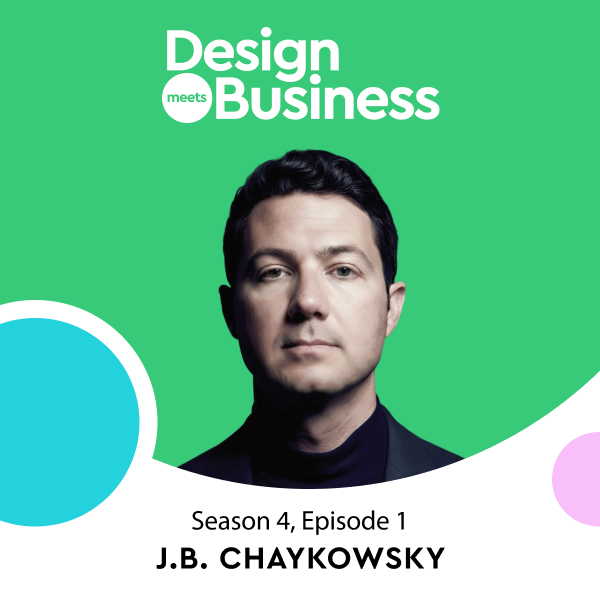
I am still critical of AI. I'm concerned that many people working on AI lack the moral standards expected of those shaping humanity's future. It's infuriating that it's about to reinvent 'work' and no one has any plans for how to deal with it. But over the past two years I've turned into an AI Optimist, as J.B. called it on my show.
Sketching with AI, Shipping with Care, and Avoiding Work Slop, with JB Chaykowsky (ex Intuit, now at Redpin)
J.B. Chaykowsky is a design and product leader with over two decades of experience spanning architecture, technology, and fintech. He spent more than 10 years at Intuit, where he led design teams and helped shape products used by millions of customers worldwide. In this episode, we discuss how to use AI effectively in design work, the importance of shipping with care, and how to avoid work slop.
It's also important to draw boundaries. I don't share with it sensitive information. I don't use it to write; my em dashes are mine alone. I absolutely refuse to outsource thinking to it; it's a thought partner, not a brain. Your boundaries might look different. You need to figure out where it fits in your life and where you prefer to keep it at bay.
In 1952, 36 people boarded the inaugural London-Johannesburg flight. It took 24 hours, made 5-stops on the way, and landing at the destination was far from guaranteed. It would've been on none of their bingo cards that their kids will be able to fly the same route in 11 hours, non-stop, sipping on rosé, watching live news on their infotainment screen, all under the umbrella of the most secure form of transportation in existence. The AI we know today is more similar to that dodgy flight than to today's modern travel.
We haven't seen the best AI has to offer yet. It's still early days. And I think it's important to not miss this train, because if it leaves the station without you, you might never catch another one.